
Introduction
IT problems rarely arrive at a convenient time. A network failure, compromised account, server issue, software outage, or missing backup can interrupt operations and create unexpected costs. For small and medium-sized businesses, maintaining every IT capability internally can also be difficult.
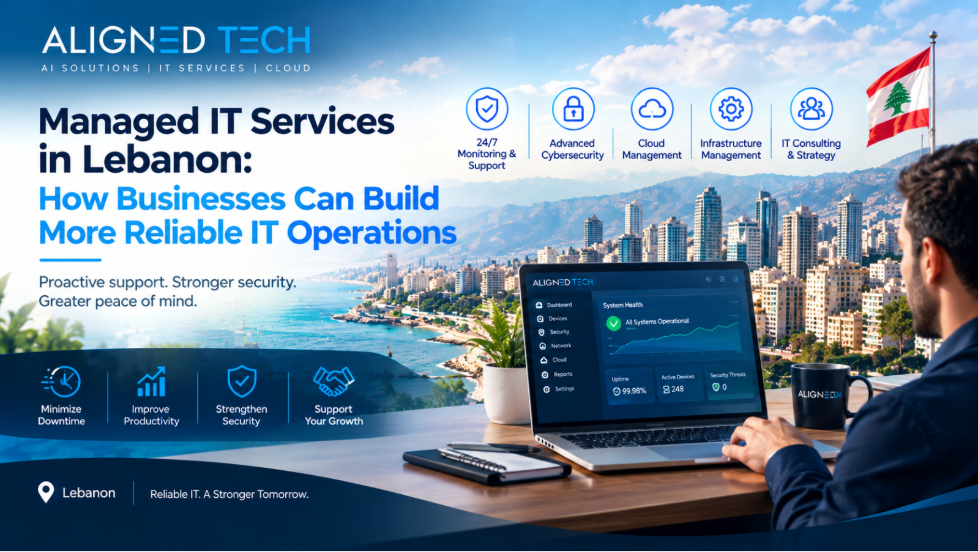
Managed IT services Lebanon can provide an alternative: a technology partner that monitors, maintains, secures, and supports the business environment on an ongoing basis rather than only responding when something breaks.
From Reactive Support to Proactive Management
Traditional IT support often starts when a user submits a ticket. Managed services add a proactive layer by monitoring systems, applying maintenance, reviewing alerts, and identifying recurring problems.
This changes the objective from simply fixing incidents to improving the reliability of the overall environment. A recurring network problem, for example, may be more valuable to investigate at the root-cause level than to fix repeatedly every few weeks.
Cybersecurity as an Everyday IT Responsibility
Security is no longer limited to installing antivirus software. Businesses need identity controls, endpoint protection, patching, backups, secure configuration, employee awareness, and monitoring.
Managed IT teams can help establish repeatable security processes. They can also support incident response planning so that employees know what to do when suspicious activity occurs.
Cloud and Microsoft 365 Management
Cloud platforms have made business systems more accessible, but they still require configuration and governance. Microsoft 365, Google Workspace, Azure, and other cloud services involve user management, security settings, backups, permissions, licensing, and monitoring.
A managed provider can help maintain those environments as the business grows. This is particularly useful when cloud responsibilities would otherwise be spread across multiple employees without clear ownership.
Backup and Disaster Recovery
A backup is only useful when it can actually be restored. Managed IT programs should therefore consider backup frequency, retention, off-site copies, access controls, and regular recovery testing.
The right recovery strategy also depends on business priorities. An application that must be restored within an hour has different requirements from a non-critical archive that can be unavailable for a day.
Supporting Remote and Hybrid Teams
Hybrid work adds complexity to identity, endpoint security, remote access, device management, collaboration tools, and help desk support. Employees need secure access from different locations without creating unnecessary friction.
Managed IT support can provide consistent policies and monitoring across the distributed environment, while giving employees a clear support path when problems occur.
Scalability and IT Planning
Technology should grow with the business. New employees, offices, applications, cloud services, and compliance requirements can all create additional IT needs.
A managed provider can help forecast those requirements, document the environment, and prioritize improvements. This can reduce the chance that technology decisions are made only after an urgent problem appears.
Choosing a Managed IT Provider
Businesses comparing providers should ask about response times, monitoring coverage, cybersecurity capabilities, backup strategy, cloud expertise, documentation, and escalation processes. It is also useful to understand exactly what is included in the monthly service and what is considered an additional project.
The best fit depends on the business environment. A small professional-services firm may need a different support model from a company operating multiple offices or a large production environment.
Working With Aligned Tech
Aligned Tech supports businesses with IT infrastructure and support, cloud services, cybersecurity-related needs, and technology consulting. For organizations evaluating Managed IT services Lebanon, a practical assessment can identify the highest-risk gaps and the areas where proactive support can provide the greatest operational value.
The focus is on making technology more predictable, secure, and manageable so employees can concentrate on the work the business actually performs.
Conclusion
Managed IT services are not simply an outsourced help desk. Done properly, they combine monitoring, maintenance, security, cloud management, backup, support, and technology planning into a more consistent operating model.
For Lebanese businesses, the right managed IT approach can create clearer ownership of technology and a stronger foundation for growth, while reducing the disruption caused by preventable IT problems.
About Aligned Tech
Aligned Tech is a technology services company focused on AI automation, chatbots, cloud solutions, IT support, and web and mobile development for businesses in Lebanon and the wider MENA region.
Service Levels and Clear Ownership
When evaluating managed support, businesses should document which systems are monitored, how incidents are prioritized, who is available outside normal hours, and how urgent problems are escalated. A clear service model helps employees know where to report problems and gives management a better view of IT responsibilities.
It is also helpful to define regular reporting. Monthly or quarterly reviews can cover recurring incidents, security improvements, backup status, device health, and upcoming technology changes.
IT Documentation Makes Support More Effective
Good documentation can include network diagrams, device inventories, application owners, cloud accounts, vendor contacts, backup procedures, and recovery steps. Keeping these records current reduces dependency on individual employees and makes troubleshooting or onboarding faster.